
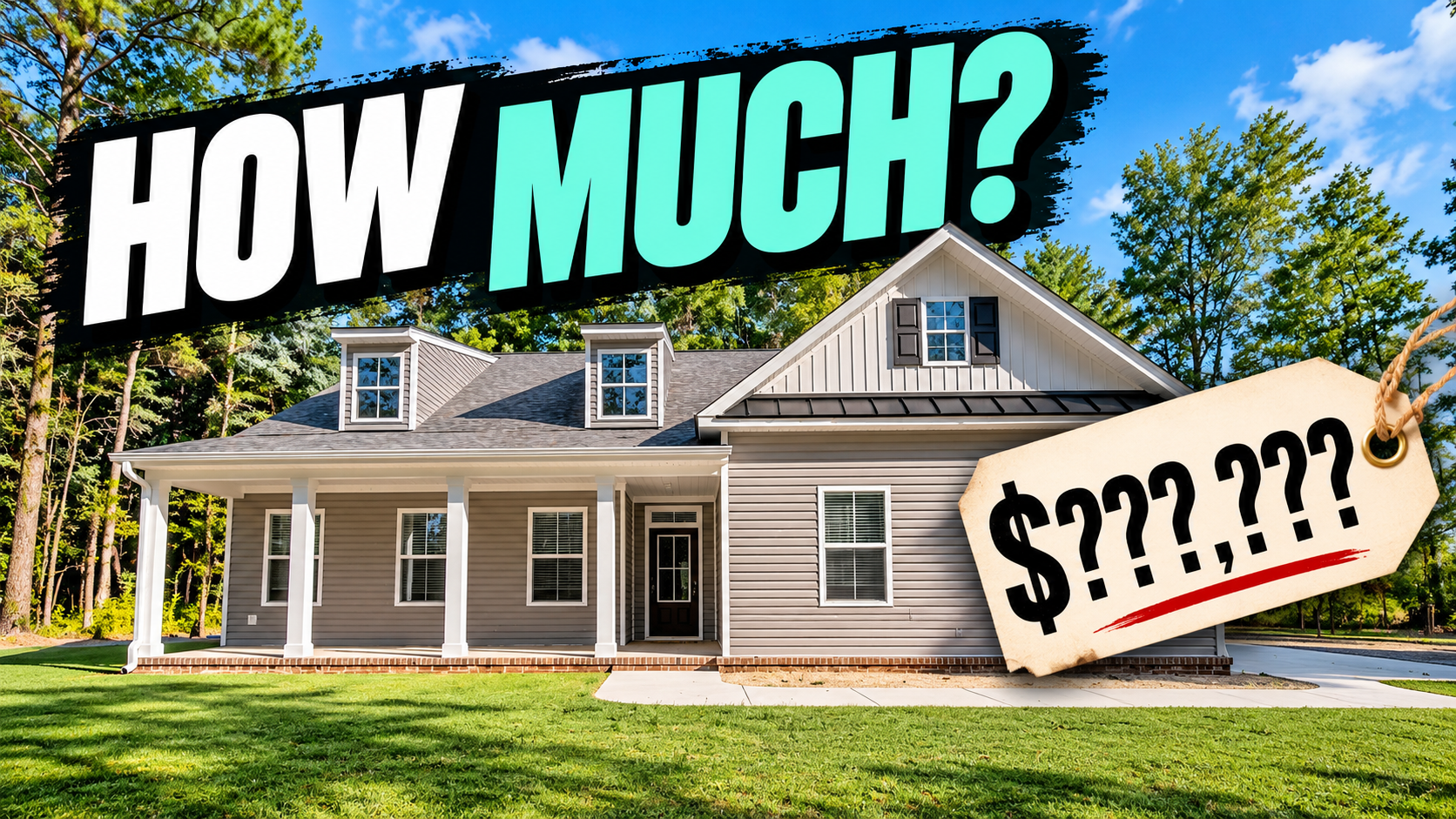
If you’re thinking about building a home, one of the first questions you’re probably asking is: How much is this actually going to cost?
Spend a little time searching online and you’ll find numbers all over the place. One builder might talk about $180 per square foot, while another project comes in at $300 or more. The problem is that those numbers don’t tell you much unless you know exactly what’s included in them.
The cost to build a house in 2026 depends on much more than square footage. Your lot, the design of the home, site preparation, finishes, utilities, permits, and dozens of smaller decisions can all move the final number. So before you start comparing builders based on a price per square foot, it helps to understand where the money actually goes.
Why Price Per Square Foot Doesn’t Tell the Whole Story
Price per square foot is an easy number to compare, which is probably why it gets so much attention. But when you’re talking about a custom home, it can also be misleading.
Say one builder quotes $200 per square foot and another quotes $250. At first glance, the first option looks like the obvious deal. But what if that $200 only covers the house itself?
Depending on how a builder calculates the number, it may not include the land, site preparation, utility connections, engineering, permits, financing, landscaping, or other costs needed to turn an empty property into a finished home.
That’s why two builders can give you similar square-foot prices while offering very different scopes of work.
Instead of asking only, “What do you charge per square foot?” a better question is: “What does that price actually include?”
Once you start looking at the entire project rather than one number, the cost of building a custom home makes a lot more sense.
Your Lot Can Have a Bigger Impact on Cost Than You Think
It’s easy to assume the house itself will determine most of your budget. But before the first wall goes up, the property can already have a significant impact on what you spend.
Picture two homeowners building the exact same floor plan. One has a relatively flat, cleared lot with utilities readily available. The other has a wooded property that needs trees removed, significant grading, drainage work, a long driveway, and possibly a well or septic system.
Same house. Very different project.
That’s why builders pay so much attention to the property before construction begins. Clearing, excavation, grading, utility access, drainage, and other site conditions all affect what it takes to get the lot ready for a foundation.
At AB Homes, looking at the property is an important part of planning the build. Understanding the site early gives the team a chance to identify potential challenges, think through what preparation will be needed, and develop a more realistic picture of the project before construction gets underway.
And once the lot is ready, another major cost factor comes into play: the design of the house itself.
Why Two Homes the Same Size Can Cost Very Different Amounts
A 2,500 square-foot house doesn’t automatically cost the same as every other 2,500 square-foot house.
The shape and complexity of the home matter just as much as the number on the floor plan.
A straightforward rectangular home with a simple roofline is generally less complicated to build than a home with multiple exterior corners, roof peaks, valleys, dormers, and other architectural details. Each of those features can mean additional framing, materials, and labor.
The same thing happens inside.
Vaulted ceilings may require additional framing. Large open spaces may need engineered beams to carry loads that would otherwise be supported by walls. Even raising the ceiling height throughout the home affects more than just the walls. You may need additional framing, drywall, insulation, paint, trim, siding, and longer runs for some of the home’s mechanical systems.
None of that means you should avoid the features you love. Having a floor plan you can customize around your priorities is part of what makes building a custom home exciting.
It simply means every design choice has a cost attached to it.
And usually, it isn’t one extravagant feature that suddenly changes the budget. It’s a larger kitchen here, taller ceilings there, a more complicated roofline, upgraded windows, an extra bathroom, and dozens of other perfectly reasonable choices adding up across the entire project.
A good custom builder should help you understand those tradeoffs while you’re making the decisions, not after the costs have already added up.
Where Does the Money Actually Go When Building a House?
When people picture the cost of construction, lumber is often one of the first things that comes to mind. Framing is certainly a major part of the build, but there is a lot more happening on a jobsite.
Before you have a finished home, you’re bringing together the foundation, framing, roofing, windows, plumbing, electrical, HVAC, insulation, drywall, flooring, cabinetry, paint, trim, masonry, exterior finishes, and plenty more.
And those pieces don’t happen independently. Different trades have to come in at the right point in the project. Materials have to be ordered and delivered. Work needs to be coordinated, inspected, and checked before the next phase can begin.
Then there are costs you won’t necessarily see when you walk through the finished house: engineering, permits, inspections, equipment, temporary utilities, dumpsters, project management, and site supervision.
So when you’re looking at the cost to build a house, you’re not simply paying for concrete, lumber, and drywall. You’re paying for everything and everyone it takes to turn a set of plans and a piece of property into a completed home.
The Cost Homeowners Don’t Always See Coming
The fun part of budgeting for a custom home is usually deciding what you want inside it.
Cabinets. Countertops. Flooring. Lighting. Appliances.
Those are tangible. You can see them, choose them, and imagine what they’ll look like once you move in.
A lot of less exciting costs happen long before you reach that stage. Engineering, surveys, permits, and site preparation can all be part of getting a custom build underway. Depending on the property, you may also need utility connections, a well, septic, stormwater management, temporary power, driveway work, landscaping, or construction financing.
Those costs can add up quickly. According to a 2026 study from the National Association of Home Builders, government regulations account for an estimated $131,734, or about 26% of the price of an average new single-family home. That figure includes regulatory costs associated with both land development and construction.
None of those choices will be the thing you show someone when they walk into your new home, but they still have to fit somewhere in the budget.
This is also why starting with a realistic understanding of the whole project matters so much. If you’re only budgeting for the house itself, expenses that are completely normal parts of building can start to feel like unexpected extras.
The earlier they’re identified, the easier it is to make informed decisions about where you want the rest of your budget to go.
So, How Much Does It Cost to Build a Custom Home in 2026?
This is where everyone wants a nice, clean number. Unfortunately, custom homes don’t work that way.
For many custom homes in today’s market, a total project investment can begin around $500,000, with larger homes, higher-end finishes, more complicated designs, and challenging properties pushing that number considerably higher. For some broader context, the average sales price of a new single-family home in the U.S. reached $523,800 in 2025, although a custom build and a home built for sale aren’t directly comparable.
But even that number needs context.
Your total project cost may involve much more than the structure itself. The land, site work, utilities, engineering, permits, and the choices you make throughout the design and construction process can all affect where the final investment lands.
It’s also why two people can build homes with very similar square footage and spend very different amounts.
One may choose a straightforward design on an easy-to-build lot. Another may build the same amount of living space on a property that requires extensive preparation and choose a more complex floor plan with higher-end finishes.
Square footage alone can’t tell you the difference.
So if you’re trying to figure out what your own home might cost, don’t get too attached to the lowest per-square-foot number you find online. Look at what’s included, what your property requires, and which design decisions matter most to you.
That’s where a useful budget starts.
Is Building a Custom Home Worth the Investment?
For the right homeowner, the value of building custom isn’t simply getting a brand-new house. It’s having a say in what that house becomes.
Instead of buying an existing home and figuring out how to make someone else’s layout work for you, building a custom home lets you make those decisions before the home is built.
Maybe you want a larger kitchen because your house is where everyone gathers. Maybe working from home means a dedicated office is non-negotiable. You may want the primary suite downstairs, more storage than you’d typically find in an existing home, or an outdoor living area you’ll actually use.
You also get to decide where quality matters most to you. That could mean higher-performance windows and insulation, an efficient HVAC system, durable materials, or simply a floor plan that still makes sense for your life ten or twenty years from now.
AB Homes starts with customizable floor plans rather than treating every home as one-size-fits-all. Room sizes, layouts, bathrooms, kitchens, finishes, and other details can be adjusted around what the homeowner actually wants from the space.
And that makes choosing the right builder just as important as choosing the right floor plan.
You want someone who can help you understand what different choices do to your budget, where spending more may make sense, and where simplifying something could free up money for a feature you’ll appreciate more.
That’s ultimately what makes the investment in a custom home worthwhile. You’re not simply spending more to make a house different. You’re deciding where your budget matters most and building a home around the way you actually plan to live in it.
If you’re thinking about building a custom home and want a clearer idea of what your project could cost, AB Homes can help you work through your plans, priorities, and budget before you build. Get in touch with the team to start planning a home that makes sense for you from day one.